“Barbie Life” by Karen Andrus
3rd place for short piece memoir, 2021
The forbidden world of Barbie swallowed me away between dinner and bedtime.
Growing up with a mother who disdained Barbie dolls (“they objectify the female body”), I naturally craved one. When I went over to Robin Morales’ house, the house with the living room furniture covered in plastic, we played Barbies for hours. I was enchanted with the accoutrements: the Barbie townhouse, the Corvette, the Beauty Shop. When I came home to my living room with the couch my mother made from a repurposed door, I never reported back about the way I’d spent the day across the street.
One Christmas, I experienced a miracle. Instead of opening gifts to reveal just socks, just books, just matchbook cars, I came upon a wrapped gift box smaller than a shoebox, but as long. After carefully pulling off scotch tape and unfolding the triangle ends of already wrinkled wrapping paper, a Mattel logo was revealed. I swallowed. Don’t get excited, I counseled myself. This could simply be a Mattel box with something else in it. After all, I’d unwrapped new socks stuffed into Tampax cartons and underwear folded inside empty cereal boxes. But as I held this present in my two hands, its weight made my heart beat faster. Once the paper was off, I turned the box over. I gasped. There in repose under clear hard plastic, in full unmistakable view, was a Francie doll. She was like Sleeping Beauty in her crystal sarcophagus, except that Francie, twisty waist and all, had eyes painted forever-wide-awake-open. She wore an outfit cuter and more mod than anything I would be permitted to wear: a snug ribbed top stretching to the wide patent leather belt at her tiny hips, followed by a polka-dotted mini skirt. Both of her soft bendable legs sported shiny white go-go boots, the very boots I coveted in real life. I gently pulled Francie from her packaging and buried my nose in her hair. The fragrance of sweet plastic, not yet touched by a human, was achingly new. I was dizzy with pleasure.
Francie was just the beginning, the pioneer who launched the trajectory into Barbie Manifest Destiny. The next member to join the Barbie family was relatively Barbie-sized, a doll I had been given at age five when my family was visiting Poland. She had not been a doll I played with; she simply sat in her traditional folk dancing outfit on a shelf with other treasures I’d collected. While she had once seemed dazzling and glamorous with the dirndl cinched around her reasonable middle, she began a new life as Francie’s doting grandmother. Francie called her ‘Babushka.’
Over time I inherited two Midges, one of whom was bald but came with two wigs, one a platinum blonde pageboy, the other a rich Brunette flip. Midges came with freckles. Otherwise they pretty much resembled Barbie dolls; it was the freckles that identified them as the best friend, not the star. Barbie was definitely top doll.
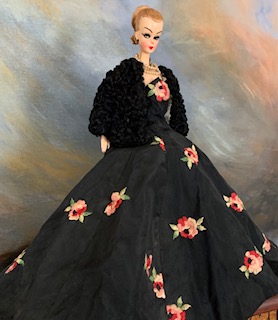
I never had a true Barbie. The closest I got to the doll in pure form was after my Great Aunt Rose learned, to her relief, that I was finally permitted to enter the Barbie Doll universe. A retired dress designer, Rose used her left-over bolts of luxe silks and lamé to create wardrobes in miniature. She mailed me a carefully wrapped box filled with meticulously sewn Barbie outfits. They were sandwiched between tiers of tissue paper, like the sheets of filoh she placed between honey and walnuts when preparing her Baklava. Under one layer of tissue was a strapless evening gown cut from frothy chiffon. Beneath another was a full cape made of ermine, the tails as long as Francie’s legs. For semi-formal occasions there was a black boiled-lambs-wool winter coat, lined with creamy satin and closed with abalone buttons.
I showed care and respect for the hand-tailored collection she gifted me. Only then did Rose take the next step. A few months after receiving her box of haute couture, another package arrived. Rose’s San Francisco address was stamped in the top left-hand corner of brown paper. The shape of the box made me expectant: it was as long as a shoebox but not as wide.
In fact I was not expecting much. I didn’t think Rose, ancient to me in her fifties, understood my Barbie passion. I thought she might send me a Barbie wanna-be, same size and shape as a Mattel product, but definitely second tier, like a Tammy doll. When I opened the package, I saw I was not far off in my prediction. It was not a Tammy, but instead, a Barbie doll of the original sort, before pliable plastic was invented. Made of hard plastic, each doll had hollow limbs and a face punctuated angrily with Joan Crawford eyebrows. This was the meanest looking Barbie I could’ve imagined. But that mean-eyed Barbie ended up playing an important role in the family unit I cultivated on the shelves of a once-empty bookcase. After all, the dynamics of relatives aren’t limited to the amiability of Francies and Midges. Mean Eyes stepped into the role of the elegant, emotionally remote matriarch.
Furnishing and accessorizing the Barbie home bordered on obsession. I was allowed the real estate of an entire low-slung bookcase occupying the back wall of the playroom I shared with my disinterested brother. My mother brought home carpet samples from the hardware store, which perfectly fit the width of the bookshelves. It was easy to accommodate Francie, Babushka, the Midges, and Mean Eyes with their own bedrooms. I cut boxes to Barbie-scaled bed-size and used a brown crayon to draw wood grain along the sides facing me. I cut up silk and wool remnants to upholster furniture I constructed from cardboard. Wallpaper samples gave each room its own personality. My favorite acquisitions were purchased with my own money on family vacations. Mexico’s open markets sold an amazing assortment of Barbie-sized furnishings. I bought a kitchen, complete with a refrigerator, sink, and stove in Oaxaca. And in Guadalajara I couldn’t breathe when I found porcelain toilets exactly the right size for my Barbies. They were gorgeous, their tanks painted with colorful flowers like zinnias, and the seats hand-brushed with gold. It didn’t matter to me that they were meant as ashtrays. I bought two of them.
A long time passed before our Barbie world flipped upside down. A Ken entered the picture, a hand-me-down from a family friend starting middle school. With Ken around, there was more tension, more arguments. The Midges alternately fought over him and blamed him for a myriad of transgressions. But it must be said: he always accepted responsibility.
When there were campouts in the backyard, Ken did the driving. Even with his sinewy muscles it was a challenge to steer my brother’s red toy pickup truck. Mindful of the inflexible cargo in the back, Ken carefully navigated through the Oxalis brushing the top of the vehicle and blocking his view. Mean Eyes issued orders for Francie and the Midges to clear the way with their machetes, which were not included in any Mattel accessory package. When the campsite was located at the base of the colossal weeping willow, the Midges were the first to climb down from the truck’s open bed into grass as high as their waists. They were the ones usually charged with setting things up and ordering Ken to find wood to chop for the campfire. Francie set off on adventures, making friends with snails. In their slow motion, they were too preoccupied to care about her attempt to harness them with rubber bands. Mean Eyes and Babushka stayed in the truck until chairs were arranged in a circle and a suitable flat spot had been located for the foam sponges that served as sleeping mats.
Ken rarely said anything during these camping trips but everyone counted on him to help pack up when the vacation was over. Once the red truck filled up with its mostly stiff-legged passengers, Ken navigated his way back over the flattened grass- roadway to the house. Driving over the first threshold was difficult and bumpy (everyone held tight to Babushka). Ken steered deftly through the kitchen and laundry room, vast walls towering on all sides, eventually reaching the playroom housing the Barbie complex. Everyone was spent and happy to be home. Babushka dragged herself directly for a nap in her room with its lavender wall-to-wall shag carpeting. Everyone else made a pit stop to use one of the two lovely porcelain toilets, which shared the plumbing in back-to-back bathrooms. Always a gentleman, Ken deferred to the ladies before taking his turn.
Mean Eyes routinely reminded him how lucky he was that the toilets had no lids. “One less opportunity for conflict!” she would declare, eyebrows in full arch. Her painted expression of perpetual disdain, like her role, was permanent. A commanding matriarch, she reminded herself, keeps a family at peace.
 Karen Andrus